
On this page
Common downspout problems
| Problem | What you see |
|---|---|
| Clogged outlet or elbow | Overflow near the downspout, silence in heavy rain |
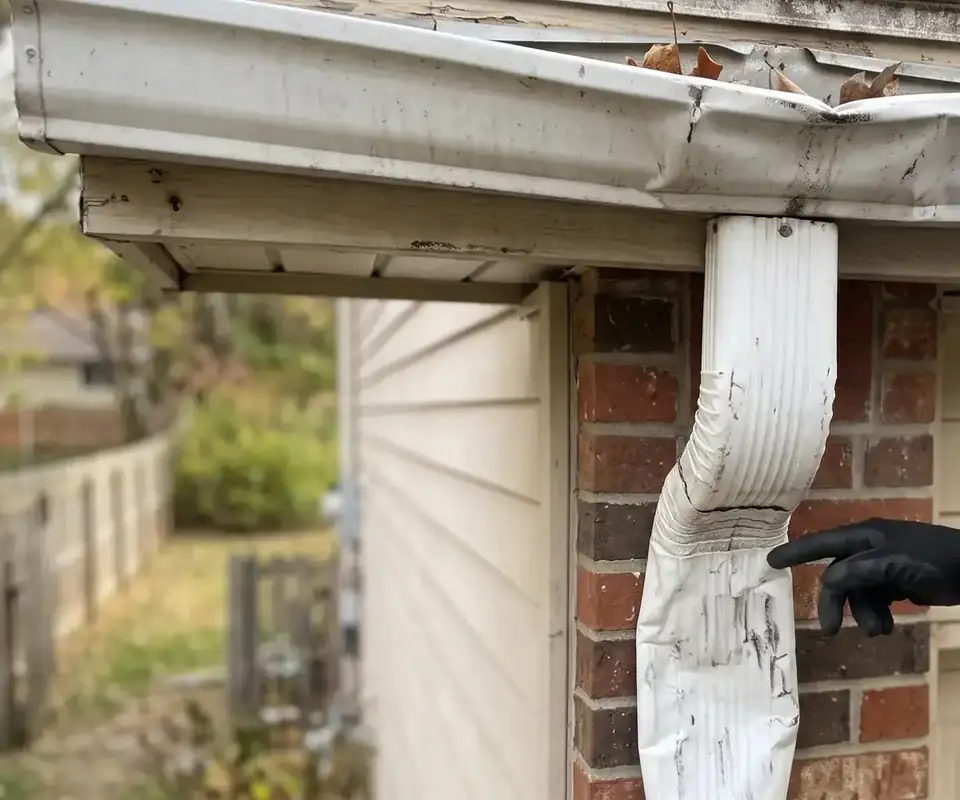
| Crushed section | Dents at mower or car height, slow drainage |
| Torn off | Downspout lying on the ground after wind or a fallen limb |
| Disconnected joints | Water spraying out partway down |
| Discharging at the wall | Wet crawl space, damp basement, eroded bed |
| Failed underground line | Water bubbling up from the pipe at the base, or soggy ground along its route |
Needles and elbows
Fir needles are the main cause of clogged downspouts in Gresham. They are small, stiff and pack tightly into the first elbow below the gutter. Once a few handfuls lodge, everything behind them stops. Larger 3x4-inch downspouts and outlets with screens or strainers help. So do gutter guards.
How repairs are done
- Clear the downspout from the top and bottom, and flush with a hose.
- Check every joint and refasten loose sections and straps.
- Replace crushed or split sections to match.
- Reattach torn-off downspouts with new straps into solid wood or masonry.
- Test any underground line by running water into it.
- Fix the discharge. Extend, reroute or add a splash block so water drains away from the house.
Gresham's rules on where water goes
The city's stormwater manual includes a standard detail for downspout extensions. Extensions are meant for lots with well-draining soil and slopes of 10 percent or less, with each downspout draining no more than 500 square feet of roof. Outlets go at least 5 feet from basement walls, at least 3 feet from crawl spaces and slabs, and at least 5 feet from the property line.
If the lot is steep, the soil is heavy, or the downspout feeds a drywell, different rules apply. The city's drywell detail sets drywells at least 10 feet from foundations and 5 feet from property lines, and requires at least 5 feet between the base of the drywell and the seasonal high water table. See downspouts, drywells and stormwater in Gresham.
Buried lines
On many houses, downspouts disappear into a pipe at ground level. Over decades those pipes fill with needles and grit, get crushed by roots, or connect to drywells that no longer take water. Signs of trouble:
- Water backing up out of the pipe at the base of the downspout
- Overflow from the gutter even when it is clean
- A soggy strip of lawn along the pipe's route
If the line cannot be cleared, the downspout can often be disconnected and extended above ground, as long as the extension meets the city's setbacks. On sites where that is not possible, a new drywell or another facility may be needed, and that is a bigger job.
What to ask
- What is blocking or damaging the downspout?
- Will you test the underground line?
- Where will the water go after the repair, and does it meet the city's setbacks?
See also downspouts and downspout drainage and your foundation.
Testing a buried downspout line
- Disconnect the downspout from the pipe at ground level.
- Run a garden hose into the pipe for five to ten minutes.
- Watch the opening. If water backs up and spills out, the line or whatever it feeds is blocked or full.
- Walk the likely route of the pipe and look for water surfacing or soggy ground.
- If it drains freely, the line is probably working, though a camera inspection is the only way to see its condition.
Why buried lines fail here
TriMet's history of the east-side neighborhoods notes that post-war builders in east Multnomah County relied on cesspools in the porous gravel soil before sewers arrived. Roof water on many lots was piped into the ground the same way. After decades, those pipes fill with silt and needles, roots grow into the joints, and some drywells simply stop taking water. On the volcanic buttes, clay-rich soils drain slowly from the start.
Disconnecting instead
Where a buried line has failed, disconnecting the downspout and extending it onto the yard is often the cheapest fix, if the site allows. Gresham's disconnection guide asks for water to leave the downspout at least 5 feet from the foundation and property lines. Portland's Environmental Services sets 6 feet from a basement and 2 feet from a crawl space. Neither city encourages disconnection where it would put water toward a basement that already floods.