
On this page
- What new gutters should do here
- How a good installation is done
- Materials and profiles
- Where the water goes
- What to ask the contractor
- Local conditions to plan for
- Types of installation
- The parts of a gutter system
- Sizing for the roof, not the house
- Installation day, step by step
- Colors and finishes
- Installation and the city's rules
What new gutters should do here
Gresham's rain comes in long spells. The National Weather Service notes that nearly 90 percent of Portland's yearly rain falls between mid-October and mid-May, and the east side gets more than the airport does: anywhere east of I-205 sees 45 inches or more in an average year. A gutter here has to carry steady water for days at a time, often while it is half full of fir needles.
That changes what matters. Size matters, because a run that is just barely big enough on paper will spill in a long downpour once the outlet starts to clog. Pitch matters, because water that sits in a flat spot grows moss and grit. And the hangers matter, because a gutter full of wet debris is heavy.
How a good installation is done
- Measure every run. The contractor measures each eave, notes inside and outside corners, and looks at where water can be discharged.
- Check the fascia. Every board that will carry a hanger gets probed. Soft or split wood is replaced first. See fascia and soffit repair.
- Choose the size. The roof area draining into each run, its pitch, and any valleys decide between 5-inch and 6-inch.
- Form the gutter on site. A machine in the driveway rolls aluminum coil into one continuous piece per run. See seamless gutters.
- Set the fall. Each run slopes toward its outlet. Long runs are often split with an outlet at each end so the gutter does not drop too far below the roofline.
- Hang it. Hidden hangers screwed into the fascia at close spacing.
- Seal and test. Corners and end caps are sealed, downspouts attached, and water is run through the system.
Materials and profiles
| Option | Where it fits in Gresham |
|---|---|
| Aluminum K-style | The standard on ranch and split-level houses. Light, rust-free, many colors |
| 6-inch K-style | Long two-story rooflines, steep roofs, valleys |
| Half-round | Older homes near downtown and craftsman-style new builds |
| Copper | Period and high-end homes. Keep zinc moss treatments off it |
| Downspouts | 2x3 or 3x4 inch, placed to drain within the city's setback rules |
Where the water goes
Gutters are only half the job. In Gresham, what happens at the bottom of the downspout is governed by the city's stormwater manual. Its standard detail for downspout extensions calls for the outlet to be at least 5 feet from basement walls, at least 3 feet from crawl spaces and slabs, and at least 5 feet from the property line. It also limits each downspout to 500 square feet of roof and expects well-draining soil and a gentle slope.
Many houses here have downspouts that disappear into pipes in the ground. Those may run to a drywell, a storm line or nowhere useful. A contractor will run a hose into each one to see whether it takes water before connecting a new downspout to it. The downspout and stormwater guide explains the options.
What to ask the contractor
- What is your Oregon CCB license number? Then check it on the CCB license search.
- What size gutter and downspout are you proposing for each side, and why?
- What hangers, and at what spacing?
- Is fascia repair included if you find rot, and how is it priced?
- Are you removing and disposing of the old gutters?
- What does your warranty cover, and for how long?
The CCB says a written contract is required for jobs over $2,000. Most full installations will be over that line.
Local conditions to plan for
Trees. East county is full of Douglas fir, western red cedar and big-leaf maple. Needles are the main thing that clogs gutters here, and they pass through coarse screens. If you plan to add gutter guards, say so before installation so the gutter and hangers suit them.
Moss. Oregon State University's Extension Service says moss on roofs is inevitable in the moist Northwest, and that the real cure is letting the sun in. Moss that washes into a gutter roots in the grit and holds water. A smooth, well-pitched gutter sheds it better.
Ice and east wind. A few times a decade, freezing rain driven by east wind out of the Columbia River Gorge coats trees and eaves. Gutters rarely fail from ice weight alone, but they do get struck by falling limbs. Close hanger spacing helps a gutter survive a glancing blow. See ice storm damage.
House age. Much of Gresham's housing dates from 1970 to 1999. Many of those houses still carry their first gutters, often sectional, on fascia that has had forty winters. Expect the contractor to find some wood to replace.
Types of installation
The parts of a gutter system
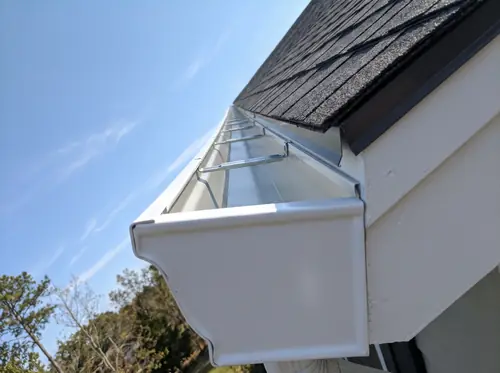
A gutter system is more than the trough on the eave. Knowing the parts makes it easier to compare quotes, because each one is a line item and each one can be done well or cheaply.
| Part | What it does | What to look for in Gresham |
|---|---|---|
| Drip edge | Metal flashing at the roof edge that carries water off the shingles into the gutter | Present and long enough to reach over the back of the gutter |
| Fascia board | The board the gutter hangs from | Sound wood or composite, primed on all faces |
| Gutter trough | Carries water along the eave to the outlets | 5-inch or 6-inch K-style, or half-round, seamless |
| Hidden hangers | Brackets inside the gutter, screwed into the fascia | Close spacing, screws not spikes |
| Miters | The inside and outside corners | Riveted and sealed from inside |
| End caps | Close the ends of each run | Sealed and riveted |
| Outlets (drops) | Holes where water leaves the gutter | Sized to the downspout; placed where water gathers |
| Downspouts | Carry water to the ground | 2x3 or 3x4 inch; strapped at top, middle and bottom |
| Elbows | Turn the downspout at the top and bottom | Large enough to pass fir needles |
| Extensions and splash blocks | Move water away from the foundation | Meet Gresham's or Portland's setbacks |
| Guards (optional) | Keep debris out | Fine mesh under conifers, screwed down |
Sizing for the roof, not the house
Two houses of the same floor area can need very different gutters. What matters is how much roof drains into each run, how steep that roof is, and whether a valley concentrates water at one spot. A low-pitched 1950s ranch in Centennial or Rockwood sheds water gently across long eaves. A 2000s two-story in Kelly Creek or Happy Valley, with steep gables and valleys, can pour most of a roof plane into a few feet of gutter. The second house often needs 6-inch gutters or extra outlets on some runs even though the first is fine with 5-inch.
Rain amount matters too. Everywhere east of I-205 averages 45 inches or more a year, and the Cascade foothill towns of Sandy, Estacada and Corbett see 55 to 65 inches. A contractor who works the east side should size accordingly.
Installation day, step by step
On a typical single-family house in Gresham the crew arrives with a trailer-mounted seamless gutter machine, coils of painted aluminum, hangers, downspouts and sealant. In one visit they usually:
- Take down and haul away the old gutters and downspouts.
- Probe the fascia, replace soft boards and fix or add drip edge.
- Snap a chalk line along each eave to set the fall toward the outlets.
- Measure, form and cut each run on site.
- Fit end caps and miters, cut outlet holes and seal everything from the inside.
- Lift each run into place and screw the hidden hangers into the fascia.
- Hang downspouts with elbows and straps, and connect extensions or tested underground lines.
- Run a hose through every section and check every outlet.
Most houses are finished in a day. Two-story houses, steep lots on the buttes, heavy fascia repair or long downspout reroutes can add time.
Colors and finishes
Seamless aluminum coil comes pre-painted in a range of baked finishes. Most Gresham homeowners match the gutter to the fascia or trim so it disappears into the roofline: white, almond, clay, bronze, black and grays are common. On brick and stone, a downspout matched to the masonry looks better than a white one. If your home is in a subdivision with an HOA, such as many newer neighborhoods in Pleasant Valley and Happy Valley, check the approved color list first.
Installation and the city's rules
Replacing gutters on an existing house is ordinary maintenance. Where the downspouts discharge, though, is covered by local stormwater rules. In Gresham, the city's standard detail for downspout extensions sets outlets at least 5 feet from basement walls and 3 feet from crawl spaces and slabs. In Portland neighborhoods such as Powellhurst-Gilbert and Lents, Environmental Services uses 6 feet from a basement and 2 feet from a crawl space. Troutdale, Fairview, Happy Valley and the Clackamas County cities have their own rules. A contractor who works the area regularly will know which apply.