
On this page
- When replacement makes sense
- Gresham houses and their gutters
- How replacement is done
- Choosing the new system
- Downspouts and the city's rules
- Coordinate with roof work
- What to ask
- What a replacement quote should include
- Replacement by age of house
- Old gutter materials you may find
- Downspout rules when replacing
- Recycling
When replacement makes sense
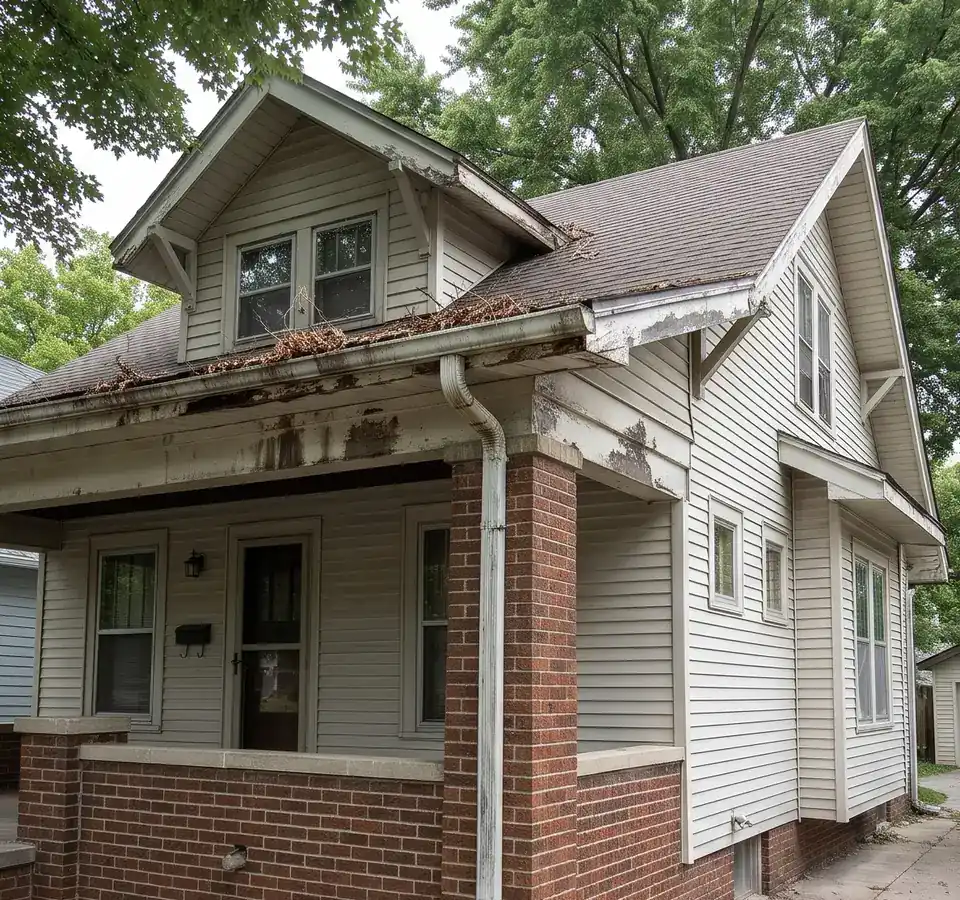
Gutters rarely fail all at once. They leak at a corner, then sag at a hanger, then start overflowing in places they never did. At some point the list of repairs costs close to what a new system would.
Signs you are there:
- Leaks at many joints, especially on older sectional gutters
- Sagging along most runs, not just one
- Rust holes in steel gutters, or aluminum that has split along a bend
- Soft, stained or crumbling fascia in several places
- Overflow every storm even right after cleaning, which points to gutters that are too small
- Patches on top of patches
Gresham houses and their gutters
Much of the city's housing went up between 1970 and 1999, with another large share from 1940 to 1969. That means many houses here are on their first or second set of gutters, and the first ones were often sectional: short lengths joined every ten feet or so, each joint sealed. After decades of wet winters, those joints and the spikes holding them are the weak points.
Older houses near downtown and in Rockwood may also have fascia that has been painted over several times, hiding rot that only shows once the gutter comes off.
How replacement is done
- Measure and assess. Every run measured. The contractor looks at the roof edge, the drip edge and the downspout locations.
- Take the old gutters down. Spikes and brackets pulled, old sealant scraped off, debris cleared.
- Repair the wood. Rotten fascia replaced, often with primed boards painted to match. See fascia and soffit repair.
- Rethink the layout. Add outlets on long runs, move downspouts that drain against the foundation, and size up where the old gutters overflowed.
- Form and hang the new gutters. Seamless runs on hidden hangers, pitched to the outlets.
- Connect the downspouts to extensions or existing lines that have been checked with a hose.
- Test with water and clean up.
Choosing the new system
| Decision | What to think about |
|---|---|
| Size | 5-inch or 6-inch, based on roof area, pitch and valleys |
| Material | Aluminum, steel or copper |
| Profile | K-style on most houses, half-round on older or period-style homes |
| Downspouts | 2x3 or 3x4 inch, and where they discharge |
| Guards | Decide now if you want guards, so the gutters suit them |
Downspouts and the city's rules
Replacement is a good moment to fix drainage. Gresham's stormwater manual sets out how downspout extensions should work: outlets at least 5 feet from basement walls, 3 feet from crawl spaces and slabs, and 5 feet from the property line, with no more than 500 square feet of roof to each downspout. If your downspouts run into pipes underground, have each one tested before the new downspouts are connected. See the downspout and stormwater guide.
Coordinate with roof work
If a new roof is coming in the next few years, talk to both contractors. Roofers often need the gutters off to replace the drip edge, and fascia is easiest to fix with the roof edge open. Doing the two together can avoid paying to remove and rehang new gutters.
What to ask
- Is fascia repair included, or priced per foot if found?
- Are you removing and disposing of the old gutters?
- Are you changing any downspout locations, and why?
- What size and material are you quoting, and what hangers?
- What warranty do you give on workmanship?
The repair or replace guide and the cost guide have more detail.
What a replacement quote should include
Replacement quotes vary more than any other kind of gutter work, because what is behind the old gutters is unknown until they come down. A clear quote lists:
| Line item | Why it matters |
|---|---|
| Removal and disposal of old gutters and downspouts | Avoids surprise haul-away charges |
| Fascia inspection, and per-foot price for any replacement | Old fascia is the most common hidden cost |
| Drip edge repair or addition | Stops water running behind the new gutter |
| Gutter size and profile on each elevation | 5-inch vs 6-inch, K-style vs half-round |
| Material and coil thickness | Thicker coil resists dents |
| Hanger type and spacing | Hidden hangers, close spacing |
| Number, size and location of downspouts | Where water goes |
| Extensions or reconnection to tested lines | Meets local setbacks |
| Guards, if any, as a separate line | Easy to compare |
| Workmanship warranty | What and how long |
National cost guides put installed seamless aluminum at about $9 to $13 a foot, with 6-inch about $3 to $5 more and $1 to $2 a foot to remove old gutters. Your quote depends on your house.
Replacement by age of house
The City of Gresham's 2021 historic survey report shows how differently the city's neighborhoods grew, and that shapes what replacement involves:
- 1950s and 1960s homes in Centennial, Rockwood, North Gresham and Wilkes East: fascia repair is common; downspouts often run into old buried lines.
- 1970s to 1990s homes on Gresham Butte and across much of the city: first-generation seamless or sectional gutters due for replacement; split-levels with many corners.
- 2000s homes in Kelly Creek and Pleasant Valley: usually tune-ups, not replacement; overflow fixes at valleys.
- Older homes near downtown Gresham, in Lents, Milwaukie and Oregon City: period profiles, careful trim repair, old drains.
Old gutter materials you may find
- Sectional aluminum, joined every 10 feet or so, with a seam to leak at each join
- Galvanized steel, rusting at seams and along the bottom where wet debris sat
- Vinyl, cracked or sagging after years of sun and cold
- Wood gutters on a few very old houses, usually rotted
- Built-in or box gutters on some older buildings, lined with metal that has failed
Each comes down differently. Wood and built-in gutters may involve carpentry and roofing as well as gutter work.
Downspout rules when replacing
Replacement is the best time to fix drainage. In Gresham, the standard downspout extension detail asks for at least 5 feet from basement walls, 3 feet from crawl spaces and slabs, and 5 feet from the property line, with no more than 500 square feet of roof per downspout. In Portland neighborhoods, Environmental Services uses 6 feet from a basement and 2 feet from a crawl space, and 5 feet from the neighbor's property line. Moving a downspout a few feet during replacement costs little; fixing a wet crawl space later costs much more.
Recycling
Aluminum gutters are recyclable, and many contractors take old aluminum to a scrap recycler. Ask what happens to yours.