
On this page
Downtown at a glance
| Area | Central City and Historic Southeast neighborhoods, around Main Street |
| Settled | 1851, when the Powell brothers claimed land at today's downtown |
| Incorporated | 1905 |
| Housing era | Peaks in the 1920s and 1940s among pre-1969 lots, per the city's 2021 survey report |
| Landmarks | Carnegie library (1913); the 1868 Roberts home, the city's oldest historic structure |
| Biggest gutter risks | Old fascia, undersized or patched gutters, buried drains |
Where Gresham began
The Oregon Encyclopedia records that brothers Jackson and James Powell claimed land in 1851 on the site of today's historic downtown. The Springwater rail line from Portland arrived in 1903, and the city incorporated in 1905. From 1907 to 1969 the Multnomah County Fair was held downtown, and in 1913 the Carnegie-funded library opened. The oldest historic structure in the city is the Roberts home, built in 1868.
The City of Gresham's 2021 Historic Survey Priorities Report says the Central City grew up around Main Street and Powell Valley Road. Of its 337 lots built before 1969, the largest groups date from the 1940s and the 1920s. That makes this the part of Gresham with the most houses from before the war.
What older houses need
| Feature | What to plan |
|---|---|
| Original or very old fascia | Probe and repair before hanging anything |
| Decorative trim | Match profiles when replacing boards |
| No drip edge | Add one, or water runs behind the gutter |
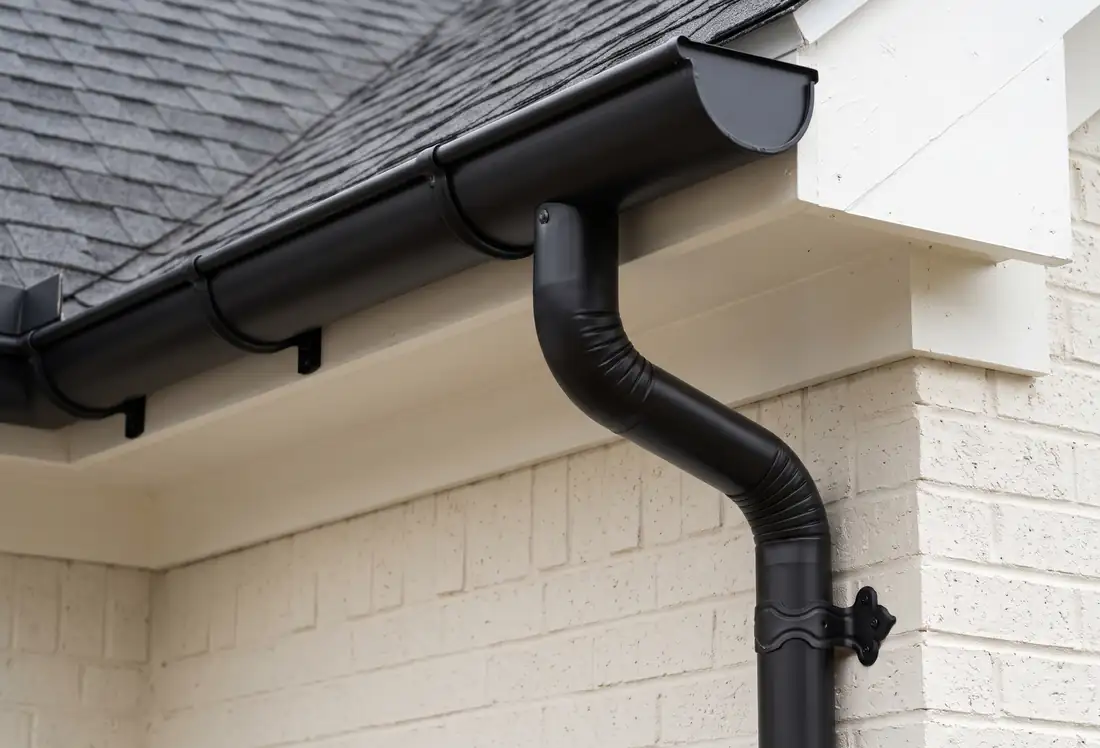
| Early-1900s styling | Half-round on brackets, round downspouts |
| Downspouts into old clay or iron pipes | Test; many no longer drain |
| Small roofs, close neighbors | Plan where water goes so it stays on your lot |
Choosing a gutter profile
On craftsman, four-square and Queen Anne-era houses, half-round gutters on exposed brackets with round downspouts often look closest to the original. Half-round carries less water than K-style at the same width, so in Gresham's rain the larger size is usually wise. On houses from the 1940s and later, K-style is the natural choice. Copper suits some older houses, but keep zinc moss treatments off the roof if you choose it.
Buried drains
Older houses downtown often have downspouts that run into pipes underground, laid decades ago. Some still work. Many are cracked, root-bound or connected to nothing useful. Before connecting new downspouts, a contractor should run a hose into each one. Where a line has failed, the choices are to repair it, extend the downspout above ground where the lot allows, or install a new facility. Gresham's downspout extension detail sets the distances. See downspouts, drywells and stormwater.
Weather
Downtown is in the middle of the east county rain belt. KPTV's summary of PRISM data puts the area east of I-205 at 45 inches or more a year, nearly all of it in the wet half of the year. Old fascia has seen a great many of those winters.
Historic properties
Several downtown-area homes are on the National Register of Historic Places, including the 1922 Hughes House listed on Wikipedia's Gresham page. If your house is listed or designated, check with the city before changing the look of the roofline. Gutters are a small part of the exterior, but on historic houses details matter.
Before you call
Look at the fascia from the ground: peeling paint, dark streaks and gaps behind the gutter all point to wood repair. Say how old the house is and whether you want to keep a period look.
Downtown landmarks and history
Downtown Gresham grew around Main Street and Powell Valley Road. The Oregon Encyclopedia records the Springwater Division rail line arriving from Portland in 1903, the Multnomah County Fair held downtown from 1907 to 1969, and the Carnegie-funded library opening in 1913. The Gresham Pioneer Cemetery dates from 1859. Main City Park and the Springwater Corridor trail are nearby, as is Johnson Creek, which has 23 percent of its watershed inside the city.
Older house styles and their gutters
| Style | Era | Gutter approach |
|---|---|---|
| Farmhouse and Queen Anne | Late 1800s to about 1910 | Half-round on brackets; repair decorative trim |
| Craftsman bungalow and four-square | 1910s to 1920s | Half-round or K-style; deep eaves, exposed rafter tails |
| Minimal traditional | 1930s to 1940s | 5-inch K-style; check fascia ends |
| Mid-century ranch | 1950s to 1960s | 5-inch K-style; hidden hangers |
Craftsman houses with exposed rafter tails often have no continuous fascia board, which changes how gutters are hung. Brackets may fix to the rafter ends or a new fascia may be added; on a period house, ask how it will look before agreeing.
Local rules
Inside Gresham city limits, the city's homeowner downspout disconnection guide asks for water to leave the downspout at least 5 feet from the foundation and 5 feet from property lines, and the standard extension detail adds 3 feet from crawl spaces and slabs. Trees 8 inches or more in diameter at four feet are regulated, so check with the city's Planner on Duty before removing one, though a tree that has fully collapsed in a storm needs no permit.
Nearby
Powell Valley, Gresham Butte, Kelly Creek, North Gresham, Rockwood.