
On this page
What makes them seamless
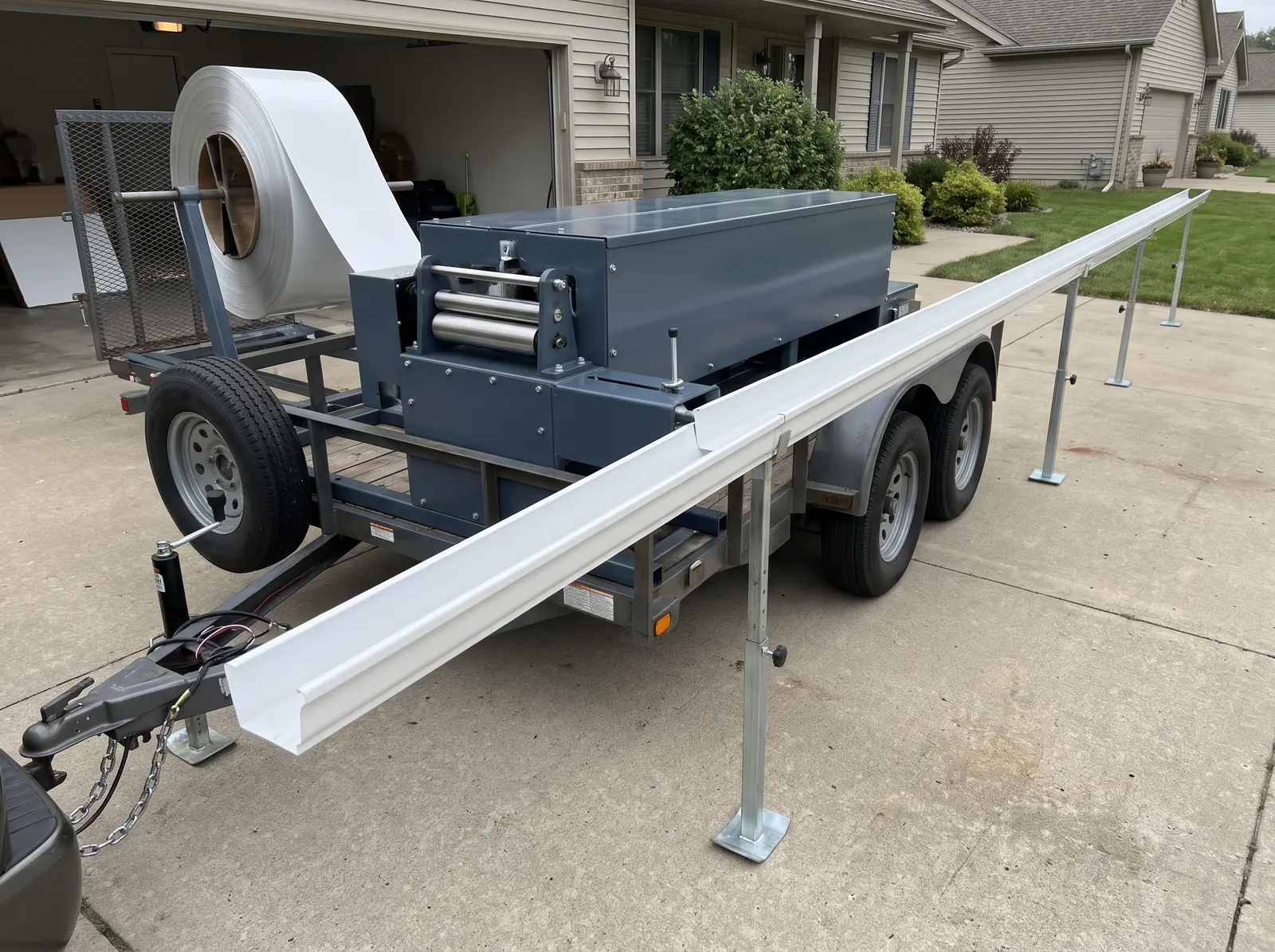
A seamless gutter starts as a flat coil of painted aluminum on a trailer. The contractor feeds it through a forming machine that bends it into a K-style or half-round profile and cuts it to the exact length of the eave. One side of the house, one piece.
Sectional gutters come in 10-foot or 20-foot lengths joined on site. Every join is a lapped, sealed seam, and every seam is a place where sealant will one day dry, crack and drip. On a house with 160 feet of gutter, that can be a dozen extra joints. Seamless gutters remove those. What is left are the joints you cannot avoid: inside and outside corners (miters), end caps, and the outlets where downspouts drop.
Why it matters here
East county rain is long rather than sudden. KPTV's summary of PRISM data puts everything east of I-205 at 45 inches or more a year. Gutters run full for days, and water sits against every joint for hours. A seam that would survive a dry climate weeps here.
The other local problem is debris. Fir needles and roof grit catch on the lip of a lapped seam and build a small dam. Water backs up behind it, and in a long winter that wet spot grows moss. A smooth, continuous trough sheds debris toward the outlet.
How a seamless installation is done
- Measure each run to the inch, including corners and the position of each outlet.
- Check and repair the fascia before anything is hung.
- Form each run in the driveway, in the chosen size and color.
- Fit miters and end caps and seal them.
- Cut outlets where the downspouts will drop.
- Hang with hidden hangers screwed into the fascia, setting a steady fall toward each outlet.
- Fit downspouts and connect them to extensions or tested underground lines.
- Run water through every section.
Seamless vs sectional at a glance
| Sectional | Seamless | |
|---|---|---|
| Joints along a run | One every 10 to 20 feet | None |
| Where leaks start | Every seam and corner | Corners and end caps only |
| Fit | Stock lengths cut down | Formed to each run |
| Debris | Catches at seam laps | Smooth trough |
| DIY | Possible | Needs the forming machine |
The seamless vs sectional guide goes into more detail.
Cost factors
Seamless gutters are priced by the foot. Angi's national guide puts installed seamless aluminum at about $9 to $13 a foot, and notes that going to 6-inch adds $3 to $5 a foot. What moves your quote:
- Total length, and how many corners
- Size, 5-inch or 6-inch
- Number and size of downspouts
- One or two stories, and access
- Fascia repair
- Removal of old gutters
- Guards, if fitted at the same time
What to ask
- Will the gutters be formed on site, and from what gauge of aluminum?
- What hangers, and at what spacing?
- How many outlets on each run, and where will the downspouts drain?
- What is your CCB license number?
See also aluminum gutters, 6-inch gutters and downspouts.
How the forming machine works
A seamless gutter machine is a roll former: a series of shaped rollers that bend a flat strip of painted aluminum coil, step by step, into the gutter profile. The coil sits on a reel at the back of the trailer. The installer sets the length, runs the machine, and a finished gutter emerges from the front, cut to size. Different roller sets make 5-inch K-style, 6-inch K-style and, on some machines, half-round. Because the gutter is made in the driveway, each run fits the eave exactly, including odd lengths around bay windows, garages and porches.
Coil, gauge and finish
The aluminum coil is sold in thicknesses, and thicker coil makes a stiffer gutter that resists dents from ladders, falling cones and branches. Ask the contractor what thickness they run. The paint is a factory-applied baked finish; a range of standard colors is usually stocked, with special colors to order.
Corners and outlets: where skill shows
A seamless run has no seams, so the quality of the job shows at the few joints that remain:
- Miters are cut and fitted at inside and outside corners, riveted, and sealed from inside the gutter.
- End caps are crimped or riveted on and sealed.
- Outlets are cut with a punch or snips, fitted with a drop, and sealed around the joint.
- Long runs may get a slip joint or expansion joint so the metal can move with temperature without tearing the sealant.
Seamless gutters on Gresham houses
On mid-century ranch houses in Centennial and Rockwood, seamless gutters usually replace old sectional systems with joints every ten feet. On 1970s to 1990s split-levels on Gresham Butte, they cut down the number of joints on houses with many short rooflines. On newer homes in Kelly Creek, most gutters are already seamless and need tune-ups rather than replacement.