
On this page
Why aluminum is the default
Most of Gresham's houses were built between the 1970s and the 1990s, according to NeighborhoodScout's census summary, and most of them carry K-style aluminum gutters or will when the originals are replaced. Aluminum suits this climate:
- It does not rust. In a place where gutters are wet for months on end, that matters.
- It is light. Less load on fascia boards that have already seen decades of wet winters.
- It forms on site. Seamless gutters are almost always aluminum because the coil runs through a portable machine.
- It comes painted. Baked-on finishes in a wide range of colors.
- It is affordable. Angi's national figures put installed seamless aluminum at about $9 to $13 a foot.
Where aluminum falls short
- Dents. Ladders, falling cones, branches and chunks of ice from the roof can dent it. Thicker coil resists this better.
- Mixed metals. Aluminum in contact with copper or bare steel corrodes in wet weather. Fasteners, flashing and hangers should be compatible.
- Heavy impacts. In an ice storm, a falling limb will bend aluminum. Steel resists better, but it is heavier and can rust once scratched.
Sizes and profiles
| Profile | Use |
|---|---|
| 5-inch K-style | Most single-story and many two-story houses |
| 6-inch K-style | Long or steep roofs, valleys. See 6-inch gutters |
| Half-round | Older or period-style homes. See half-round |
| 2x3 downspouts | Standard with 5-inch |
| 3x4 downspouts | With 6-inch, or on 5-inch where needles clog outlets |
Hangers
The hanger matters as much as the gutter. Old houses often have spikes driven through the gutter into the fascia. Spikes work loose as the wood swells and shrinks through wet winters and dry summers. Hidden hangers clip inside the gutter and are screwed into the fascia, and they hold far better. Spacing matters too: closer hangers carry the weight of wet needles and the odd load of ice.
Colors
Match the trim or fascia so the gutter disappears into the roofline. White, almond, bronze, black and grays are the common choices. On brick, a downspout matched to the brick color looks better than a white one.
Aluminum and moss treatments
Aluminum is not affected by zinc moss treatments the way copper is, which is one reason it is the practical choice on east county roofs where moss is treated regularly. Chemical runoff still ends up in the gutter and downspouts, so rinse the gutters after a roof treatment and follow the product label on where runoff can go.
Life expectancy
Aluminum itself lasts a long time. What fails first on most old aluminum systems is the sealant at corners, the spikes or hangers, and the fascia behind. That is why so many sagging, leaking aluminum gutters can be repaired rather than replaced, and why a new system should be hung on hidden hangers into sound wood.
What to ask
- What thickness of aluminum coil do you use?
- What hangers, and at what spacing?
- Are the gutters formed on site?
- How many downspouts, what size, and where will they drain?
- What is your CCB license number?
See also seamless gutters and the materials guide.
K-style aluminum: the anatomy
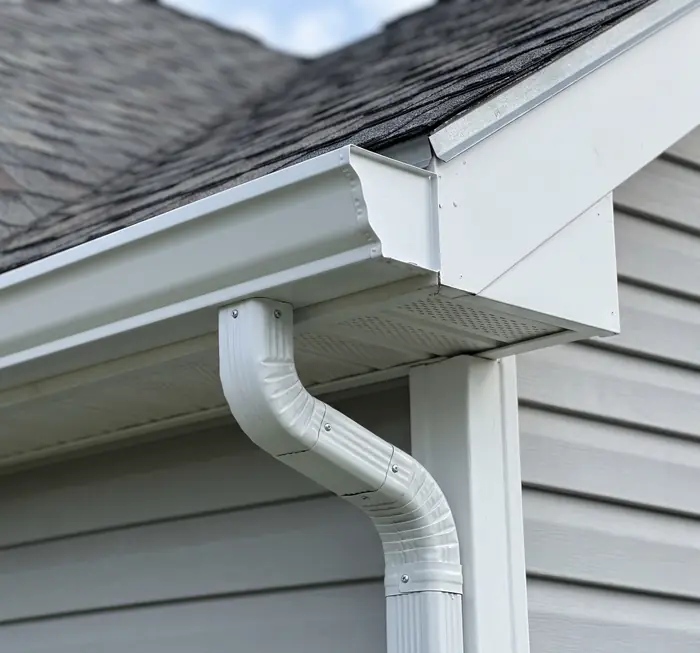
A K-style gutter has a flat back that sits against the fascia, a flat bottom, and a front shaped like crown molding with a rolled top edge (the lip or bead). Hidden hangers clip under the lip and screw through the back into the fascia. The shape is stiff for its weight, holds more water than a half-round of the same width, and looks finished from the street.
Spikes, ferrules and hidden hangers
Older aluminum gutters were often hung with long aluminum spikes driven through the front of the gutter, through a tube called a ferrule, and into the fascia. Over wet winters and dry summers the wood swells and shrinks, and the spikes work loose. Hidden hangers sit inside the gutter under the lip and are fixed with screws, which hold much better. Replacing spikes with hidden hangers is one of the most common gutter repairs on mid-century houses in Rockwood, Centennial and North Gresham.
Common colors
| Color | Often used on |
|---|---|
| White | Sided ranch and split-level houses |
| Almond, clay, beige | Earth-tone siding and trim |
| Musket brown, dark bronze | Wood, stone and dark trim |
| Black | Modern farmhouse and contemporary styles |
| Grays | Newer homes with gray or charcoal siding |
Match the gutter to the fascia for a clean roofline, and the downspout to the wall it runs down.