
On this page
When 5-inch is not enough
Most houses in Gresham have 5-inch K-style gutters, and on a simple single-story ranch that is usually enough. The trouble starts when a lot of roof drains into a short stretch of gutter. Common causes:
- Long two-story eaves with one downspout at the end
- Steep roofs, where water moves fast and can shoot past the gutter lip
- Valleys, which collect two roof planes and pour into one spot
- Upper roofs draining onto lower ones, so the lower gutter carries both
- Large newer houses with big roof planes, common in Pleasant Valley and Happy Valley
Gresham's rain does not come as violent bursts as often as it does in the Midwest, but it comes in long, steady spells. The NWS notes that nearly 90 percent of the year's rain falls between mid-October and mid-May. A gutter that is close to its limit and starts to clog with needles will spill again and again over a winter.
What 6-inch gives you
A 6-inch gutter is wider and deeper. Installers and home-service companies commonly say it handles up to 40 percent more water than a 5-inch gutter. Angi's sizing guide pairs 5-inch K-style with 2x3-inch downspouts and 6-inch with 3x4-inch downspouts, which carry a lot more water and are harder to clog with needles and cones.
That last point matters here. Many overflow problems are really outlet problems: a 2x3 downspout jammed with fir needles. A 3x4 outlet is far more forgiving.
Signs you need it
| Sign | Likely cause |
|---|---|
| Overflow at the same spot in every heavy rain, even when clean | Too much roof into one run |
| Water shooting over the front at a valley | Concentrated flow, small gutter |
| Overflow near the downspout but not the far end | Undersized or clogged outlet |
| Splash marks or a trench in the bed below the eave | Repeated overflow |
| Lower gutter overflowing under an upper roof | Upper roof draining onto lower |
Before upsizing, rule out the simple causes: a clogged outlet, a run that has sagged flat, or a gutter set too low under the drip edge.
Other ways to add capacity
- More outlets. Adding a second downspout to a long run halves the water each section carries.
- Bigger downspouts. A 3x4 outlet on a 5-inch gutter helps on many houses.
- Valley diverters. Small baffles that stop water overshooting at a valley.
A good contractor will look at all of these, not just sell a bigger gutter.
Fascia and hangers
A 6-inch gutter full of water and wet needles is heavier than a 5-inch one. It needs sound fascia and close hanger spacing. If the boards are soft, they must be replaced first. See fascia and soffit repair.
Cost
Angi's national figures put the step up from 5-inch to 6-inch at $3 to $5 more per linear foot. Use the calculator on the home page to compare, and read the 5-inch vs 6-inch guide for the full comparison.
Downspouts matter as much as the gutter
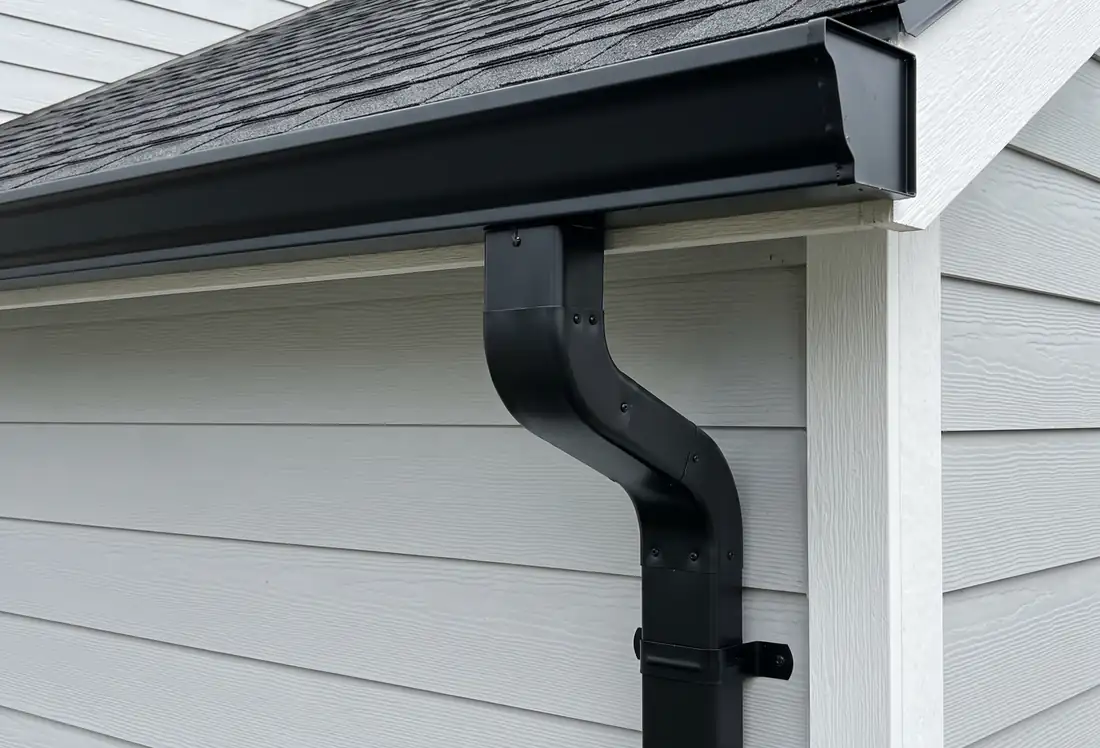
A 6-inch gutter is usually paired with 3x4-inch rectangular downspouts, which have a much larger cross-section than standard 2x3s. In practice, the bigger downspout often makes the larger difference here, because the point of failure in east county is so often an outlet jammed with fir needles. Some contractors fit 3x4 downspouts to 5-inch gutters for exactly that reason.
Where 6-inch is common around Gresham
| Area | Why |
|---|---|
| Happy Valley, Pleasant Valley, Kelly Creek | Larger newer homes with valleys and long eaves |
| Sandy, Estacada, Corbett | 55 to 65 inches of rain a year, per KPTV's PRISM summary |
| Boring, Damascus | Shops, barns and big outbuilding roofs |
| Commercial and apartment buildings | Large roof areas |
Hanging a heavier gutter
A 6-inch gutter full of water, needles and the occasional load of ice weighs more than a 5-inch one. Hangers should be screwed into solid wood at close spacing. On houses where the fascia is thin or decorative, a contractor may add a backing board or use hangers that fasten into the rafter tails. Ask how they will support it.
Matching the look
On a two-story house with deep fascia boards, a 6-inch gutter looks in proportion. On a small single-story house with narrow fascia, it can look heavy. A common compromise is 6-inch on the rear and long side eaves where the water is, and 5-inch on the front, joined with transition corners.