
On this page
What sagging tells you
A gutter should run in a straight line with a slight, steady fall toward each outlet. When it dips between hangers, tilts away from the house or pulls away at one end, it is telling you something has let go. The longer it is left, the more water sits in the low spot, the heavier it gets, and the faster it pulls.
The usual causes
Weight. A gutter full of wet fir needles, cones and moss is heavy, and here it stays wet all winter. Hangers that were fine when the gutter was clean start to bend or back out.
Spikes. Many older houses have their gutters held up by long spikes driven through the gutter into the fascia. As the wood swells in winter and shrinks in summer, spikes work loose. You can often see their heads standing proud.
Spacing. Hangers set too far apart let the gutter flex between them.
Ice and impact. Freezing rain coats gutters and the eave, and limbs fall on them. In the February 2021 storms, PGE estimated that every inch of ice on a foot of power line added about 3 pounds. Gutters carry ice too.
Ladders. Leaning a ladder against a gutter bends it and loosens hangers.
Soft wood. If the fascia has rotted, no hanger will hold. See fascia and soffit repair.
How it is fixed
- Clean the gutter to take the weight off and see what is wrong.
- Check the fascia along the run. Soft spots are found and marked.
- Remove old spikes and loose hangers.
- Set the line. A string line or level marks the correct fall toward each outlet.
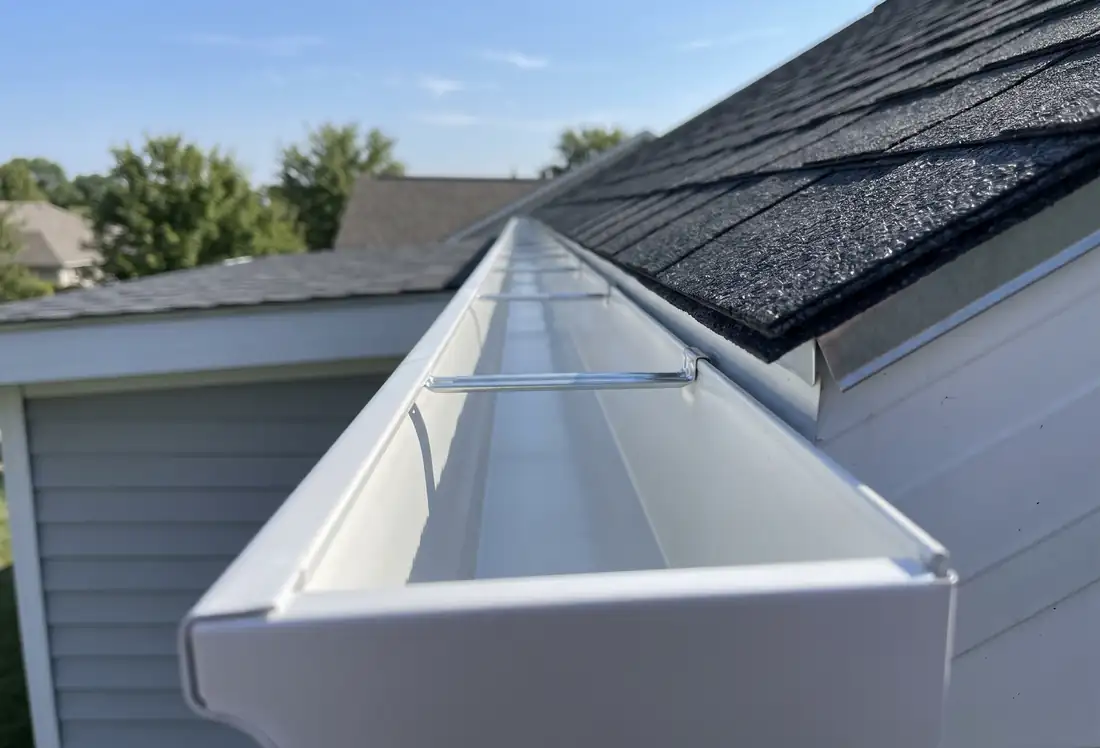
- Rehang with hidden hangers screwed into solid wood, at close spacing.
- Straighten or replace sections that are kinked or creased.
- Reseal any joints disturbed in the process.
- Test with water.
When it is not worth rehanging
- The gutter is creased or split along its length
- Several runs are sagging and the system is old and sectional
- The fascia needs replacing along most of the house anyway
- The gutters are too small and overflow even when level
In those cases, look at gutter replacement.
Prevention
- Keep gutters clean, especially before the winter rains. See gutter cleaning.
- Never lean ladders on the gutter.
- Ask for hidden hangers at close spacing when gutters are installed.
- Consider gutter guards under heavy conifers to cut the weight of debris.
Sagging and overflow
A sag does not have to be large to cause trouble. A low spot of half an inch holds water and debris between rains, so the run never quite dries out. Moss and grit settle there, and the extra weight makes the sag worse. If you see water standing in one section a day after rain, or a line of drips along the front edge in the middle of a run, the gutter has probably lost its fall there.
What to ask
- Is the fascia sound, and how will you check?
- What hangers, at what spacing?
- Will you re-pitch the whole run or just lift the low spot?
- What is your CCB license number?
Spike, ferrule and hanger types
| Fastener | How it works | Problems |
|---|---|---|
| Spike and ferrule | Long spike through the gutter face and a tube into the fascia | Backs out as wood swells and shrinks |
| Strap hanger | Metal strap nailed to the roof deck under the shingles | Hard to replace without lifting shingles |
| Wraparound hanger | Cradles the gutter from below | Visible; can loosen |
| Hidden hanger | Clips under the front lip, screwed through the back | The current standard; holds well |
How much fall a gutter needs
A gutter needs a slight, steady slope toward its outlet so water and debris move along it. Too little and water pools; too much and the low end sits far below the drip edge, where water can miss it. On long runs, contractors often slope from the middle to an outlet at each end. When rehanging a sagging gutter, the contractor snaps a chalk line on the fascia to set the line before fixing hangers.
Sagging on older Gresham houses
Mid-century houses in Centennial, Rockwood, North Gresham and the Portland neighborhoods east of I-205 were often built with spiked gutters. After sixty or seventy winters of rain and summer drying, spikes are the first thing to go. Rehanging on hidden hangers usually fixes the sag, provided the wood behind is sound.